Omigod. I was laughing so hard at the Halo 3 review I had trouble breathing.
http://www.escapistmagazine.com/articles/view/editorials/zeropunctuation/
Thanks to Ken Tan.
26 October 2007


09 October 2007
Kanazawa Reunion
Three of us who studied in Kanazawa got back together this weekend for a reunion in Kanazawa and had a blast! We persevered despite the fact that several of our old haunts have been ravaged by time -- both Famille and Biz Cafe are no more :-(
Nevertheless Kanazawa is still "ii machi". Frances is wild for purikura (print club) so we made a couple really fun images!
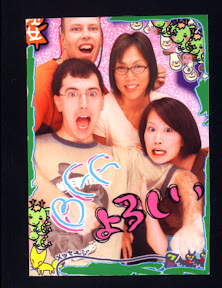
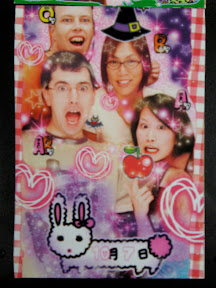
Nevertheless Kanazawa is still "ii machi". Frances is wild for purikura (print club) so we made a couple really fun images!
25 September 2007
Lots More Photos
Jason posted his photos from my friends' recent visit to Japan! Albums from things I did include:
http://www.luminpro.com/gallery2/v/visits/070920_tokyopia_meet/
http://www.luminpro.com/gallery2/v/visits/070918_tokyopia_pretgs/
http://www.luminpro.com/gallery2/v/visits/070916_hakonemuseum/
http://www.luminpro.com/gallery2/v/visits/070916_ank/
http://www.luminpro.com/gallery2/v/visits/070915_kansuiro/
http://www.luminpro.com/gallery2/v/visits/070915_hakone/
http://www.luminpro.com/gallery2/v/visits/070914_tokyo_misc/
Whew! That was a long week! Thanks for the photos Jason!
Leo
20 September 2007
Mysteries of the Japanese Culinary Mind
Today I got a Beef Croquette Sandwich for lunch (the Japanese love croquettes so much, they put them inside bread as a sandwich), and as a dressing, the sandwich had... tartar sauce. Hmm....
17 September 2007
One of the coolest museums ever
This weekend we went to the Hakone Open-Air Museum. It's an awesome museum, primarily dedicated to sculpture and mainly outside in the open air.
Photos are here, I'll post links to everybody else's photos as they get uploaded.
Leo
Photos are here, I'll post links to everybody else's photos as they get uploaded.
 |
| HakoneOpen |
Leo
13 September 2007
12 September 2007
Indie Anim Fest
While I was in Korea I met up with my friend Jenny Hsoo, and she mentioned the Korean Indie Animation Festival (which she started a couple years ago, although she's no longer involved).
It's restricted to independent or student works from within Korea, and they had over 200 entries this year! There's a lot of stuff going on in Korea. They accepted 32 entries, I found the trailer on a Korean news site. It was cool to hear about all the activity in the indie scene!
Leo
It's restricted to independent or student works from within Korea, and they had over 200 entries this year! There's a lot of stuff going on in Korea. They accepted 32 entries, I found the trailer on a Korean news site. It was cool to hear about all the activity in the indie scene!
Leo
04 September 2007
03 September 2007
Umi Hotaru
So over the weekend we had an offsite meeting over in 千葉県 Chiba-ken at a town called 金谷 Kanaya. We got there by driving through the Tokyo Bay Aqua Line, which is a freeway that passes under half of Tokyo Bay in a tunnel, and then turns into a bridge for the remaining distance.
The place where the tunnel comes out and turns into a bridge is called 海ほたる Umihotaru. Hotaru means firefly, and umi means sea, so "ocean's firefly?" It's a HUGE man-made building in the middle of Tokyo Bay.
 |  |
| Back towards Tokyo | Forwards towards Chiba |
The place where the tunnel comes out and turns into a bridge is called 海ほたる Umihotaru. Hotaru means firefly, and umi means sea, so "ocean's firefly?" It's a HUGE man-made building in the middle of Tokyo Bay.
 |  |  |
| It's 5 stories tall, so you park in one of the lower levels and then go up... | ...and up... | ...and up... |
| ...and up... | ...and finally come out on top where the views are! | |
 |  |
 | Fundamentally, this is what we used to call a "tourist weir" -- it's job is to slow down the tourists so they'll spend money in the shops. It seemed to be a very popular spot to stop, which I was slightly surprised by given that the whole trip across Tokyo Bay only takes about 30 min. At right, Tomoyo and Hitomi enjoy the bay sun. At below left, Shuzo tried to take a picture in the breeze. Below right, some of the insane infrastructure around this man-made island. |  |
 |  |
28 August 2007
That's not pain, that's passion!
From the camera of Jason Kim at our Karaoke session in SF!

Next up: Karaoke in Tokyo!

Next up: Karaoke in Tokyo!
26 August 2007
Rhapsody in August, and storytelling
Yesterday I went with some friends to this month's installment of the Akira Kurosawa festival in Mitaka. Although I missed most of it, every month this festival shows one or two of Kurosawa's movies, in mostly (but not precisely) chronological order.
One of the things that surprised me when I first went to the festival is that, while Kurosawa's name is well-known, he's not a standard reference point of people in the industry, the way he is in the US. In the US, you can pretty safely assume that anyone in the entertainment business has seen Seven Samurai, and Rashomon; and that they have some idea of Kurosawa's ouvre outside that. Before this festival, I had probably seen seven or so of Kurosawa's movies (my favorite, hands-down, is Ikiru).
However, that wasn't the point of this post! Yesterday we watched Ran, his beautifully cinematic remake of King Lear; and Rhapsody in August, which is what this post is about.
Rhapsody is not a bad film, in fact I enjoyed most of it. For one thing, after the hig opera of the jidaiteki (period) films and the out-and-out weirdness of Dou Desu Ka Den, watching Kurosawa direct normal characters in Rhapsody was a great break (the primary characters are a grandma who survived the Nagasaki atomic bomb, and her materialistic grandchildren). The movie definitely is an old man's movie (Kurosawa was 81 when he made it), and it reflects an old man's attitude about the decline of culture. However, it's still a reasonable story about the reconciliation of several generations and despite their differing priorities.
The things that were controversial at the time of the film's release seem like total non-issues to me; the film has a very negative view of the atomic bombing, but it's a film about a family who lost their patriarch to the bomb so that's natural. Some depictions of American were criticized as obsequious, apologizing for the bomb; but in fact Gere's character seemed to me to simply be having a humane response to the loss the characters around him had suffered.
But the story is another thing. Again, most of the film is good, as by small moments the grandchildren and grandma come to grips with each other. The grandma is slowly losing touch, which is portrayed very straightforwardly. But the ending ruined the movie; namely, that there isn't one. At the end of the movie, there's a another "grandma is losing touch" episode, but it has no consequences and no resolution (in fact, we don't even see the end of the episode; the movie cuts abruptly to credits while the families are chasing the determined grandma down a dirt road in a torrential rainstorm).
There simply is no coda, no ending, no meaning assigned to the issues the characters have been dealing with for two hours. Will the families move to Hawaii or not? (this is the central plot question of the film) Don't know. Will grandma go? Can she continue to live alone in this country house near Nagasaki? Don't know. That might all be fine if the final sequence provided some character insight that justified it; but it doesn't.
Making this extra-scary, the group I was this with was happy with the ending. Why? Because it "didn't put an explicit meaning on the movie." Sure, that's like saying you enjoyed the evening because an axe murderer didn't assault you; true, but no defense of the events. No, you don't have to tie everything in the plot up neatly with a ribbon on top, but a story should have a sense of conclusion at the end.
Now, the friends I saw this with are all highly educated, well-versed members of the industry. The reason their reaction scared me is because it made me think, "Will Japan ever be able to make mainstream worldwide entertainment?" If you've been through even the slightest amount of the mainstream story-development thread in America, it's painfully clear what was wrong with the ending: there's nothing the characters have learned and brought back to their lives. Happy ending, sad ending, whatever: audiences want a feeling that the events of the story have come to a stopping place. If you were a live storyteller around a campfire, and you tried to end the way Rhapsody in August does, your audience wouldn't let you go!
Sigh, it's gonna be a hard struggle to get successful content produced here.
----------------
----------------
Now playing: Vampire Weekend - Cape Cod Kwassa Kwassa
via FoxyTunes
25 August 2007
Appliances, Pt. 2
The refrigerator was freezing the vegetables, so I was motivated to follow on to the earlier post of "Kanji you might find on a washing machine" with this one, "Kanji you might find on a refrigerator".
| Kanji | Reading | Meaning |
|---|---|---|
| 冷蔵庫 | reizouko | Refrigerator |
| 冷蔵室 | reizoushitsu | Refrigerator compartment (lit. "room") |
| 冷凍室 | reitoushitsu | Freezer compartment |
| 設定ロック | settei rokku | Setting lock |
| 強 | tsuyo(i) | strong |
| 中 | chuu | medium |
| 弱 | yowa(i) | weak |
| ソフト冷凍 | sofuto reitou | Soft freeze |
| 急冷凍 | kyuureitou | Fast freeze |
| キッチンタイマー | kicchin taimaa | Kitchen timer (yes, my refrigerator has a built-in kitchen timer) |
| スタート | sutaato | Start |
| ストップ | sutoppu | Stop |
----------------
Now playing: The Proclaimers - I'm Gonna Be (500 Miles)
21 August 2007
Another miracle of Multi-lingual Product Marketing
The toilet paper randomly bought at the nearby 24-hour store is called Elleaire.
The tag line says (in English), "Elleaire is made with the finest quality and ultimate softness, in order to bring comfort back into your life."
Below that, it says, in Japanese, "100% Pure Pulp."
The tag line says (in English), "Elleaire is made with the finest quality and ultimate softness, in order to bring comfort back into your life."
Below that, it says, in Japanese, "100% Pure Pulp."
Subscribe to:
Posts (Atom)