Mesmerizing, I was especially fascinated by the Hummingbird & Dragonfly.
Just let the movies play: Vision Research.
28 January 2008


21 January 2008
19 January 2008
Awesome, awesome things to do with your Wiimote
This guy at CMU has definitely been thinking about creative ways to use the Wiimote! The head-tracking demo is righteous. Leo Bob sez check it out.
http://www.cs.cmu.edu/~johnny/projects/wii/
http://www.cs.cmu.edu/~johnny/projects/wii/
17 January 2008
08 January 2008
05 January 2008
Great book on Japanese Film
My interest in (and even knowledge of) Japanese film started in graduate school. My friend Ken Carson offhandedly said, "Hey, I'm going to go see The Seven Samurai this weekend, want to come?"
"What's that?" I replied, never having heard of the film.
"Oh," Ken answered, "it's the greatest action movie ever made."
I thought that was a bit overhyped, but it certainly piqued my interest, so I went. The next Monday another friend asked me, "So, what did you think of Seven Samurai?"
"Oh," I answered, "it's the greatest action movie ever made."
Since then I've not only watched most Kurosawa movies but moved into the more esoteric realms of Yasujiro Ozu and others. Then, along came Donald Richie's One Hundred Years of Japanese Film, which I picked up at Kinokuniya last weekend.

This is a dense but great book surveying the rise of the Japanese industry (at its height, in 1960, Japan made 537 movies) and the unusual aspects of the industry such as the long tradition of benshi, narrators used for silent movies who surivived in Japan for decades. It also covers fairly carefully the fall of the industry in the 60s and 70s: like everywhere, television was the main culprit, but the Japanese industry's response was in the end less effective than Hollywood's.
There are longish sections on Ozu, Kurosawa, and Mizoguchi but the real appeal of the book is its thoroughness: every studio and many, many directors are described, as are hundreds of films. I wrote a longer review of the book here.
"What's that?" I replied, never having heard of the film.
"Oh," Ken answered, "it's the greatest action movie ever made."
I thought that was a bit overhyped, but it certainly piqued my interest, so I went. The next Monday another friend asked me, "So, what did you think of Seven Samurai?"
"Oh," I answered, "it's the greatest action movie ever made."
Since then I've not only watched most Kurosawa movies but moved into the more esoteric realms of Yasujiro Ozu and others. Then, along came Donald Richie's One Hundred Years of Japanese Film, which I picked up at Kinokuniya last weekend.
This is a dense but great book surveying the rise of the Japanese industry (at its height, in 1960, Japan made 537 movies) and the unusual aspects of the industry such as the long tradition of benshi, narrators used for silent movies who surivived in Japan for decades. It also covers fairly carefully the fall of the industry in the 60s and 70s: like everywhere, television was the main culprit, but the Japanese industry's response was in the end less effective than Hollywood's.
There are longish sections on Ozu, Kurosawa, and Mizoguchi but the real appeal of the book is its thoroughness: every studio and many, many directors are described, as are hundreds of films. I wrote a longer review of the book here.
30 December 2007
I scream, you scream, we all scream for Krispy Kreme
As with so many trends, a little while after it hit California, Krisy Kreme mania is on in Japan. There's one store in Shinjuku (as it turns out, two doors down from the Starbuck's the started the Japanese Starbuck's craze), and even after a few months the lines are insane.

The line stretches more than halfway across the bridge across the railroad at Shinjuku.

As you can see by the mufflers and coats, it was cold in Tokyo today! It didn't intimidate the line-waiters.
Needless to say, I didn't partake of the Krispy Kremes this day!

The line stretches more than halfway across the bridge across the railroad at Shinjuku.

As you can see by the mufflers and coats, it was cold in Tokyo today! It didn't intimidate the line-waiters.
Needless to say, I didn't partake of the Krispy Kremes this day!
Good but not Great
I just finished "The Pillars of the Earth" by Ken Follett. I gather this is a shade more highbrow than his other books (although I haven't read any of his other books AFAIK), and it was good. It's a historical novel about the building of Kingsbridge Cathedral, and it brings in lots of information about medieval architecture, English civil wars, church vs. state in merry olde Englande, and so forth.
Those parts were all good, but... it's hard not to compare this to Iain Pears' "An Instance of the Fingerpost," which is the finest historical novel even written, and it definitely suffers in the comparison. The characters in Follett's book are well-drawn, but not always well-motivated; there are a few too many convenient coincidences and a few superfluous elements. So, if you like historical novels, Pillars is definitely worth a read; however, everyone (who has the patience) should read Instance of the Fingerpost.
Those parts were all good, but... it's hard not to compare this to Iain Pears' "An Instance of the Fingerpost," which is the finest historical novel even written, and it definitely suffers in the comparison. The characters in Follett's book are well-drawn, but not always well-motivated; there are a few too many convenient coincidences and a few superfluous elements. So, if you like historical novels, Pillars is definitely worth a read; however, everyone (who has the patience) should read Instance of the Fingerpost.
23 December 2007
Holiday Music: The true worldwide constant
So, the Japanese may not believe in Christmas as a holiday (there are still incredibly few Christians here, the opposite of Korea), but as with holiday lights, they love Christmas carols. Every store here is the same experience as in the US of A, lots of Rudolph, Jingle Bells, etc., etc. Like in the US, this started right at Thanksgiving.
In general, I find the Japanese are a little bit classier about it: it tends to be some jazz or classic vocalist (think Andrews Sisters) version, not so much the Mitch Miller. On the other hand, my friend said the store he was just in was playing the "Chipmunks Sing Christmas" album so...
In general, I find the Japanese are a little bit classier about it: it tends to be some jazz or classic vocalist (think Andrews Sisters) version, not so much the Mitch Miller. On the other hand, my friend said the store he was just in was playing the "Chipmunks Sing Christmas" album so...
20 December 2007
Singapore at night from above
So, I booked my room at the Swisshotel because it's next door to the place I was going, but it turns out to not only be a very nice hotel, but also a very tall hotel -- my room was on the 55th floor! As a result, from my balcony I had gorgeous views of the city, which were especially compelling at night.
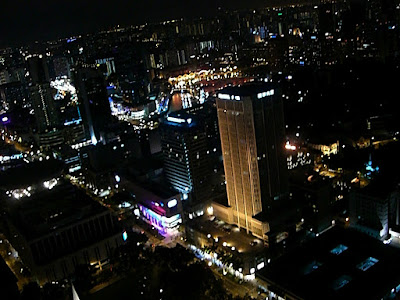


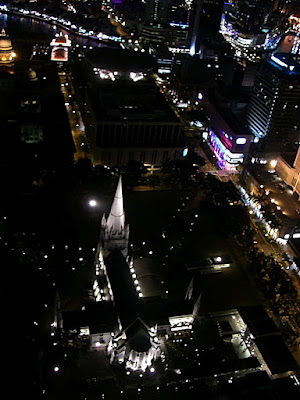
The above picture is the Chijmes complex, a converted convent that's now a fun nightlife area.

The body of water in the distance is Clarke Quay, another nightlife area. Also, hard to see at night, the huge round structure in the lower right is the Singaporean Supreme Court.


The above picture is the Chijmes complex, a converted convent that's now a fun nightlife area.

The body of water in the distance is Clarke Quay, another nightlife area. Also, hard to see at night, the huge round structure in the lower right is the Singaporean Supreme Court.
Never Before Seen in Aviation History
On my flight to Singapore last Sunday, the plane's departure time was changed... to be earlier!
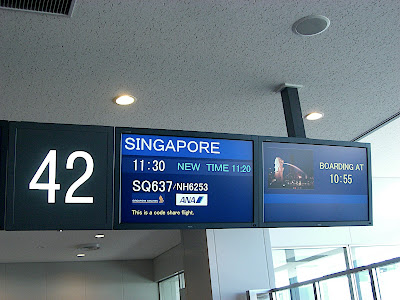
Yes, you read that correct: original departure time 11:30, updated departure time 11:20. I guess they were hoping nobody tried to cut it close that day!
Yes, you read that correct: original departure time 11:30, updated departure time 11:20. I guess they were hoping nobody tried to cut it close that day!
11 December 2007

10 December 2007
More FF Miles
Well, after all our Singapore trainee program looks like it's going forward, so I'm off to Singapore for a 4-day trip starting Sunday. Time for some Chicken Rice!
07 December 2007
02 December 2007
Shimokitazawa
Every time I've gone out to Shimokitazawa I've had a good time, whether it was eating at an Okinawan restaurant with Makino-san, discovering an awesome Japanese beer emporium or hanging at a hookah bar with Eldred.
After the JLPT today I stopped by Shimokitazawa again, and I'm more convinced than ever it's a future trendy neighborhood. All the ingredients are there: arty fashion and performance spaces, trendy student bars and clubs ("live houses" as they're called here); multiple train lines; and lower-than-current-average apartment prices (maybe still 40% under central Tokyo). I hung out in a local record store and discovered a couple fun new Japanese bands, saw the crowds and the energy... I'm telling ya, invest in Shimokitazawa real estate now! ;-)
After the JLPT today I stopped by Shimokitazawa again, and I'm more convinced than ever it's a future trendy neighborhood. All the ingredients are there: arty fashion and performance spaces, trendy student bars and clubs ("live houses" as they're called here); multiple train lines; and lower-than-current-average apartment prices (maybe still 40% under central Tokyo). I hung out in a local record store and discovered a couple fun new Japanese bands, saw the crowds and the energy... I'm telling ya, invest in Shimokitazawa real estate now! ;-)
Subscribe to:
Posts (Atom)