01 November 2008

Japan is a place where

you can stand in the same location *, look one way and see this ultramodern scene:

From Tokyo

then turn around and see this one:
From Tokyo


* Meguro Atre

28 September 2008

Ghibli Layout Exhibition

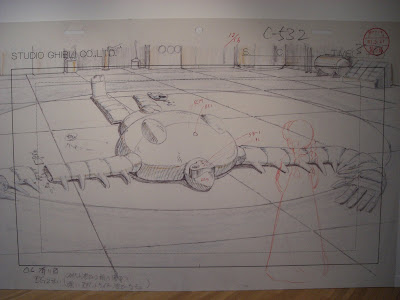
Today I went to the Studio Ghibli Layout Exhibition at the Tokyo Museum of Modern Art, curated by my friend Tomoe Moriyama. It was awesome! They had 1300 pieces of layout art from Studio Ghibli, representing all the movies.

Most of the exhibit was, not surprisingly, forbidden to photograph, but at the end they had several *huge* reproductions of Layouts:

From Tokyo


From Tokyo


(look at the floorboards to get an idea how big these were)

From Tokyo


This was the line to get into the the gift shop at the end. Talk about lost sales!

From Tokyo


They had a really cool activity at the end of the tour. They handed out little round paper stickers, and there was a table of black markers, so you could make your own "kurosuke" (from the dust bunny spirits in the movie My Neighbor Totoro).

From Tokyo


And then they had a lot of wallspace to put your korosuke up on:

From Tokyo


I mean, really a lot of wall space:

From Tokyo


This was a fantastic exhibition and a real opportunity for any Ghibli fans. Unfortunately, today was the last day, so you won't be able to go again! If you do get a chance to get one of the catalogs, though, go for it: it is fantastic. I'm not sure yet, but I think it actually has all 1300 layouts from the show.

20 September 2008

Hyperrealistic painting site

http://oekyo.org/06/

This site has painting of various qualities, and it looks like they were mostly done by copying photographs. But the cool thing is that you can watch the painting get made -- the software they use can do an auto-time-lapse of making the image. Click on the little button above each image that says ★動画 and, if you have Java installed, you can watch the painting get painted.

My favorite was DIR EN GREY, #2507.

Language Geeking - Equivalent of Japanese Counters in English

One of the hardest things for a native English speaker studying Japanese (or Chinese) is the idea of counters, or as linguists call them, classifiers.

In Japanese when counting things, you can't just use the number: you have to append a counter to the number to refer to that thing. You can't see, "As for pencils, I had three"; you have to say, "As for pencils, I had three-long-thin-things". This is a generic rule, with lots of different counters for different kinds of things, which need to be memorized.

In fact, as Japanese teachers like to point out, we do have counters in English, but they're quite rare. The famous example is "sheets" for paper. You can't have "one paper", you have "one sheet of paper" (you can have one scientific paper, but that's a different use of the word paper). I recently realized that 'pair' is a counter for both pants and scissors; it functions exactly like 'sheet of paper' (and all of them are excellent analogies to how counters function in Japanese).

I just finished reading Steven Pinker's new book, "Words and Rules," and as you might expect from the most prominent linguist of this era, at one point he rattles off a whole list of English classifiers! I didn't want to lose track of it, so here it is.
blade of grass
piece of fruit (you can't have "two fruits")
strand of hair *
slice of bread
stick of wood
sheet of paper
head of cattle


* I think this is a weak example -- in the classic joke the customer says, "Waiter! There's a hair in my soup!" not "Waiter! There's a strand of hair in my soup!" I think people do routinely say "one hair", "two hairs" etc.

08 September 2008

Do you need to characterize tactile pressure contact between mating surfaces?

Below is a message which is almost certainly the coolest piece of spam I've ever received.

Still, it's spam, so I wouldn't click on any of the links in it if I were you.


On Sep 9, 2008, at 12:46 AM, Joseane Delfino wrote:

Dear Engineer

Do you need to characterize tactile pressure contact between mating surfaces? This unique thin plastic-like sensor film is actually placed between any two contacting or impacting surfaces. Immediately upon pressure being applied, the film records the precise pressure distribution and magnitude that occurs bychanging color. Conceptually similar to Litmus paper, the color that pressure indicating film turns is directly proportional to the amount of force applied.

Pressure indicating film is an ideal tool to aid in QC/QA in both your manufacturing processes as well as R&D endeavors.

Example Applications


Click on one button below to select the sensor film sample that you would like us to send you:
`


Micro* 2 - 20 PSI (0.14 - 1.4 kg/cm2)


Ultra Low 28 - 85 PSI (2 – 6 kg/cm2)


Super Low 70 - 350 PSI (5 – 25 kg/cm2)


Low 350 - 1,400 PSI (25 – 100 kg/cm2)


Medium 1,400 - 7,100 PSI (100 – 500 kg/cm2)


High 7,100 - 18,500 PSI (500 – 1,300 kg/cm2)


Super High 18,500 - 43,200 PSI (1,300 – 3,000 kg/cm2)

*Shows relative pressure distribution only
If you experience any difficulty with the links above, you can click here to register for information/sample requests, just mention the code EXPV82 in your comments.
Sensor Expert, USA
300 Madison Avenue, Madison NJ, 07940
Tel. 973 929 2167
http://www.sensorexpert.com/

sales@sensorexpert.com


PS. The first 25 responses will receive a complementary optical analysis of their exposed pressure indicating sensor film. Simply send us the sample once you’ve used it and we will email you a detailed report. Promotion code “


EXPV82”. This sample offer is valid until 9/30/2008.

30 August 2008

Beach House Happiness

Last night I went to maybe the coolest place I've been in Japan. My friend Yoko took me to the Blue Moon Cafe, a beach house out on the beach in Hayama, near Kamakura.


Beach house means it's not a real structure: it's a roof over the sand. In the case of the Blue Moon, it's actually done with bamboo for both the uprights and the roof (the more commercial beach houses near Kamakura are tin over a steel frame). Hayama is in general a lot less crowded and a lot less tacky than the more accessible beaches. I was there in the evening and it was raining, at some points intensely; but we just hung out underneath the bamboo roof.


Like the tourist season in Shonan in general, things are only happening during the summer. Blue Moon takes this to the full extent: it's only open in July and August, and the night we went was the next-to-last night for the year. It is seriously right on the beach, 20 yards from the surf. In addition to the bar/kitchen area and the stage, Blue Moon has a set of booths across the back of the beach house that range from selling hand-made locally-designed clothing, to promoting sustainable conservation measures, to a really good Chinese tea house.


Blue Moon has live music, dance, or other performances almost every night. Last night it was three guys who play traditional Okinawan music, with the lead musician and singer on sanshin, one guitarist (not visible in photo), and a multi-instrumentalist on the right who at various points played mandolin, violin, and even trombone! I really enjoyed hearing them, although I'm sure Okinawan folk music isn't for everybody.


The crowd at Blue Moon was great. For one thing, although it doesn't show in the pictures, in Japan there's effectively no drinking age and there are no laws about separating children from adults having a good time, so there were all sort of kids at Blue Moon running back and forth through the crowd and playing on the beach. And, the crowd was extremely friendly and mellow, lots of people said hi and we met a number of folks. There were a surprisingly large number of foreigners, which appears to be kind of true of Hayama and Shonan in general. However, they weren't the obnoxious foreigners that you sometimes find in Roppongi; it was more foreigners who seem to have settled into Japan for a bit and are comfortable there.

Blue Moon was a great experience and I hope to be able to get there for the 2009 version!

A Great Bit of Analysis, and Doomed to be Ignored

This excellent article in the New York Times is about how the rich and poor fare under Republican and Democratic administrations.

But few outside the New York intelligentsia will read it, I suspect, for the article takes a fantastic lead ("New Study Confirms that under Republicans, the Rich get Richer and Poor Left Behind") and buries it under multiple layers of introduction that will drive away any but the most intellectual reader.

  • The headline is a question, implying that the issue is under debate. In fact, Bartels' book (which is what the article is about) is shockingly clear about the historical record that Republican administrations are bad for everyone but the rich.

  • The headline talks about history, which is one of the best ways to get rid of any mainstream readers (for better or for worse, most American audiences don't care about history; those that do, watch The History Channel). If this was an article about history, that would be fine, but it's not: this is actually an article about politics.

  • The first two paragraphs start out with a tour through history and end up at democrats vs. federalists. He doesn't actually get to the lead of the article until his fourth paragraph about the Great Partisan Growth Divide. My friend Bill Polson routinely sends around example of this new style of quasi-reporting from the LA Times. I don't know if it comes from new NY Times style guidelines or merely from the writers wanting to feel like they're prose stylists, but I think it clearly makes the article less accessible as a source of information.

  • I'm very much a math-friendly person and even I found the explanation of how many percentiles get measured, what the measurement intervals were and so forth to be very dry. I realize he's trying to ensure himself against innumeracy in the readership, but the result makes the article even less casually readable.


The reason the above things bothered me so much is that they talk to why, when objective measurement clearly shows Republicans are much worse for most of the people in the country, many if not most people vote Republican on a regular basis. The contents of this article should be a incendiary bomb to the majority of Republican supporters, middle-class voters who may be church-goers but who also want to see their children make it through college. Those Republican you put in office are denying your Children their Future!

But you can't pose that kind of urgent issue in terms of historical trends if you want to affect the people who most need the information. If you look at Bartels' various quantiles of families, the ones at the bottom are not the most likely to read an article that starts out talking about history. You need to frame the discussion in clear ways that affect people now, not by placing it in context as a continuation of a fundamental debate begun at the very founding of the country. It's not that the historical approach is wrong; it's that taking such a highbrow path to explaining the facts, rather than the likely consequences on the reader, means the message is much less likely to get to the people who would suffer the most from a Republican administration.

As a Democrat, I'm continually appalled by the way the Republicans in the last twenty years have been more successful at packaging the issues where they are strong (Democrats want to Deny you the ability to Practice your Faith!) than Democrats are at packaging the issues where they are strong (Study Confirms Republicans are good only for the Rich!). Alan Blinder is a smart guy and a good writer, but his article seems to continue in that bad-packaging tradition that has lost so many elections for Democrats.

25 August 2008

The eternal question: Why?

While looking for a good tutorial on object-oriented Python for my Python seminar, I found this excellent article on how to write a solver for all Sudoku puzzles in about 100 lines of Python. I great article, but unless you're particularly interested in programming just scroll down to the hilarious section titled "Why?".

Denial of service attack on human intellect, indeed!

Stratfor's Latest

For some time I've subscribed to a free email blast from Stratfor.com, which I find very informative. In particular it has a lot to say about Georgia and how this crisis was clearly predictable from the resolution in Kosovo.

Georgia and Kosovo: A Single Intertwined Crisis

Say what you will about the Russian regime, I think if you follow Stratfor's analysis you'll see that Kosovar independence was very problematic in terms of international law, and Georgia is a surprisingly parallel situation (just not one aligned with the interests of the United States). When the Kosovo independence debate was raging, Stratfor's email blast noted that it would provoke a Russian reaction and correctly suggested that it would likely come in Georgia.

Why Hollywood is a Bunch of Idiots

There's something about the Hollywood culture that produces behavior of such titanically bad logic that Spock's brain would explode. Today's exhibit:

Batman to reboot Superman

Mind-boggling logic error summary (other illogic is left as a fun exercise for readers!):

  1. Because a Batman movie is successful, Superman movies will be successful.

  2. Because the last Superman movie wasn't successful, it must be all Bryan Singer's fault. *

    But the real kicker is...

  3. Because 2 superhero movies were successful this year, we're going to make 8 superhero movies a year! That way we'll be four times as successful!


My god, does no one remember the gluts of movies past (westerns, scifi, fantasy et al have all had their turn at the plate)? Making 8 movies a year at Warner, plus whatever gets made elsewhere, is the surest way to kill the whole genre and make sure Warner loses money on 8 movies.

Quick advice for Mr. Robinov: write 8 superhero movie scripts a year. Make the one or two best ones into movies. You'll make more money, and we won't hate you.

I've never met Mr. Robinov, but I've met some Hollywood executives and they were generally smart people. That's why I'm always puzzled when I read these things: it seems like more than the individuals, there must be some aspect of the system that causes this sort of bad thinking.

* In the end, directors get a fair deal, though, since if the movie is successful everyone assumes it was all the director's genius.

21 August 2008

Neat 3D Game

Beautiful implementation of this idea!

http://www.bobblebrook.com/games/coign-of-vantage

Courtesy of Lori King's FB.

02 August 2008

For those who run websites

Not particularly news, but I thought well-summarized. Quoted from the presentation at http://plone.tv/media/689203036/view:
Some Web 2.0 Characteristics:
  • A lot of users are accessing the top items with high bandwidth
  • The "Long Tail" is being accessed constantly (by web search crawlers)
  • A lot of personalization, stale content for logged-in users is no option

We're running into all of these even on siggraph.org (not a particularly high-volume site), which is why I was watching the video.