http://www.slate.com/id/2186848/
Has anybody seen Crayon Physics Deluxe in person? It certainly looks awesome in the video!
20 March 2008


17 March 2008
Piperoidz -- Way cool new Japanese figures
I went to the Konica-Minolta Plaza in Shinjuku to check out the Geoscape exhibition, which was great. But actually the coolest thing I saw was in an ecology-themed exhibition next door: Piperoids!
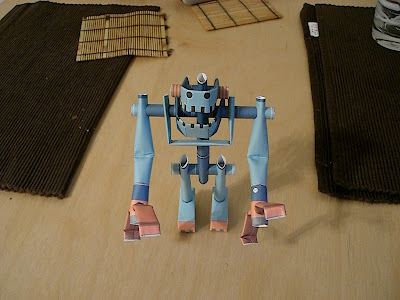
It may not be immediately evident from the pictures why Piperoids are so cool -- they come as cardboard tubes, and nothing but cardboard tubes. You assemble them yourself from a bunch (usually 5) of cardboard tubes.
They're really an ingenious set of paper-folding and tube-nesting ideas (some of the tubes differ in diameter by exactly one thickness, so that they can function as bushings for each other!). They generally look cool, and there's a lot of clever stuff in how they go together. I don't know if they've made it to the states yet, but keep your eyes out for them!
16 March 2008
Spring is almost here in Tokyo
In Japan, the marker of spring is cherry blossom season, which is usually around end of March / beginning of April in Tokyo. The National Meteorological Agency keeps a running forecast of Cherry Blossom times here.
My more personal method is to check the progress of the buds of the cherry trees along the Meguro-gawa near my house. And they're agreeing with the Agency -- it's close. Here's a shot of the developing buds on some of the cherry trees just outside.

If you've never experienced Cherry Blossom time in Japan, it's an incredible experience -- but one very hard to describe in words. I can't wait!


15 March 2008
Nassim Taleb's "Fooled by Probability"
On a recent plane flight, I saw a copy of Nassim Taleb's "Fooled by Probability" and picked it up. Taleb is the author of the excellent "The Black Swan", a book about extremely rare events with a large effect on the world, and is a New-York-based trader who has managed to pull his living out of making slightly better probabilistic bets than others.
"Fooled by Probability" is a book about the general confusion that results in the human brain when confronted with matter relating to probability. This isn't a new theme -- there's some great material on the same subject in Richard Dawkins' seminal "The Selfish Gene" -- but Taleb definitely brings interesting and relevant anecdotes, and a little bit of research, to the topic.
He talks repeatedly about how we 'prefer the narrative' -- that is, we will search for a causal narrative in any series of events -- and the everyday manifestation of this in such inane headlines as "Dow down 3 points on inflation rumors". Yet, he's not foolishly prescriptive: he recognizes that the preference for the narrative is not something we can choose to discard, it's wired into us just as is the fact we remember emotions more readily associated with smells than sights.
And that's exactly the problem with the book: this book is a collection of observations and insights about humans dealing with probability, not a book that's actually about something. In that sense, it's clearly an earlier book than The Black Swan: by the time he wrote the second book, he had progressed as an author to the point where he could put together many of these same observations and insights into a more coherent book which is about something.
Thus, if you've already read "The Black Swan", reading "Fooled by Probability" is more about visualizing the progression of Taleb as an author than about new material on probability. It's interesting enough to read that I wouldn't recommend against it for that reason; but, if you haven't read either one yet, pick up "The Black Swan" rather than this one (and if you haven't read "The Selfish Gene" yet, that's your first stop!).
17 February 2008
Summer Days with Coo
At the Japan Media Arts Festival yesterday, I attended a screening of Summer Days with Coo / クウと夏休み, a charming film about a fourth-grader who befriends a Kappa.
Kappas are mythical Japanese water sprites, surprisingly strong for their size and completely at home in water. They're often used as a cautionary tale to keep Japanese kids away from the local ponds ("Don't go swimming in that pond, or the Kappa will get you!") and are famed for their trickery. Also, they have a wet spot in the middle of the top of their head, which they have to keep moist in order to stay alive.
The film is classic 2D animation, and while the story isn't epic in any way -- it's almost entirely concerned with Coo and his host family -- it's touching. It does open with a Finding-Nemo-like scene of Coo's trauma, but in general it's in the same vein as "My Neighbor Totoro," just a little less compelling all around.
The animation ranges from awesome (there's a beautifully animated Chinese dragon in the middle of the movie) to awful (some of the interactions with other kids at the end are just disturbingly off-model), but overall the story is well-told. It's too bad the rest of the world doesn't know what Kappa are: the storytelling is completely international, but if you don't know about Kappa a lot of the scenes will be a little mysterious.
Ironically, that wasn't the film we went to the festival to watch. We went there to see a very different film that showed just before Coo: Koji Yamamura's "A Country Doctor," a very trippy piece of surrealistic animation based on Kafka's story. It was well-executed in its own way, and intellectually the visuals were worth watching. However, it was the opposite of Coo in that it doesn't function very well as a piece of entertainment -- you have to watch it for the sake of the visuals.
05 February 2008
01 February 2008
Hold it!
In case you haven't run into this, one of Improv Everywhere's best actions yet.
http://www.improveverywhere.com/2008/01/31/frozen-grand-central/
http://www.improveverywhere.com/2008/01/31/frozen-grand-central/
28 January 2008
Awesome photography hacking
Mesmerizing, I was especially fascinated by the Hummingbird & Dragonfly.
Just let the movies play: Vision Research.
Just let the movies play: Vision Research.
21 January 2008
19 January 2008
Awesome, awesome things to do with your Wiimote
This guy at CMU has definitely been thinking about creative ways to use the Wiimote! The head-tracking demo is righteous. Leo Bob sez check it out.
http://www.cs.cmu.edu/~johnny/projects/wii/
http://www.cs.cmu.edu/~johnny/projects/wii/
17 January 2008
08 January 2008
05 January 2008
Great book on Japanese Film
My interest in (and even knowledge of) Japanese film started in graduate school. My friend Ken Carson offhandedly said, "Hey, I'm going to go see The Seven Samurai this weekend, want to come?"
"What's that?" I replied, never having heard of the film.
"Oh," Ken answered, "it's the greatest action movie ever made."
I thought that was a bit overhyped, but it certainly piqued my interest, so I went. The next Monday another friend asked me, "So, what did you think of Seven Samurai?"
"Oh," I answered, "it's the greatest action movie ever made."
Since then I've not only watched most Kurosawa movies but moved into the more esoteric realms of Yasujiro Ozu and others. Then, along came Donald Richie's One Hundred Years of Japanese Film, which I picked up at Kinokuniya last weekend.

This is a dense but great book surveying the rise of the Japanese industry (at its height, in 1960, Japan made 537 movies) and the unusual aspects of the industry such as the long tradition of benshi, narrators used for silent movies who surivived in Japan for decades. It also covers fairly carefully the fall of the industry in the 60s and 70s: like everywhere, television was the main culprit, but the Japanese industry's response was in the end less effective than Hollywood's.
There are longish sections on Ozu, Kurosawa, and Mizoguchi but the real appeal of the book is its thoroughness: every studio and many, many directors are described, as are hundreds of films. I wrote a longer review of the book here.
"What's that?" I replied, never having heard of the film.
"Oh," Ken answered, "it's the greatest action movie ever made."
I thought that was a bit overhyped, but it certainly piqued my interest, so I went. The next Monday another friend asked me, "So, what did you think of Seven Samurai?"
"Oh," I answered, "it's the greatest action movie ever made."
Since then I've not only watched most Kurosawa movies but moved into the more esoteric realms of Yasujiro Ozu and others. Then, along came Donald Richie's One Hundred Years of Japanese Film, which I picked up at Kinokuniya last weekend.
This is a dense but great book surveying the rise of the Japanese industry (at its height, in 1960, Japan made 537 movies) and the unusual aspects of the industry such as the long tradition of benshi, narrators used for silent movies who surivived in Japan for decades. It also covers fairly carefully the fall of the industry in the 60s and 70s: like everywhere, television was the main culprit, but the Japanese industry's response was in the end less effective than Hollywood's.
There are longish sections on Ozu, Kurosawa, and Mizoguchi but the real appeal of the book is its thoroughness: every studio and many, many directors are described, as are hundreds of films. I wrote a longer review of the book here.
30 December 2007
I scream, you scream, we all scream for Krispy Kreme
As with so many trends, a little while after it hit California, Krisy Kreme mania is on in Japan. There's one store in Shinjuku (as it turns out, two doors down from the Starbuck's the started the Japanese Starbuck's craze), and even after a few months the lines are insane.

The line stretches more than halfway across the bridge across the railroad at Shinjuku.

As you can see by the mufflers and coats, it was cold in Tokyo today! It didn't intimidate the line-waiters.
Needless to say, I didn't partake of the Krispy Kremes this day!

The line stretches more than halfway across the bridge across the railroad at Shinjuku.

As you can see by the mufflers and coats, it was cold in Tokyo today! It didn't intimidate the line-waiters.
Needless to say, I didn't partake of the Krispy Kremes this day!
Good but not Great
I just finished "The Pillars of the Earth" by Ken Follett. I gather this is a shade more highbrow than his other books (although I haven't read any of his other books AFAIK), and it was good. It's a historical novel about the building of Kingsbridge Cathedral, and it brings in lots of information about medieval architecture, English civil wars, church vs. state in merry olde Englande, and so forth.
Those parts were all good, but... it's hard not to compare this to Iain Pears' "An Instance of the Fingerpost," which is the finest historical novel even written, and it definitely suffers in the comparison. The characters in Follett's book are well-drawn, but not always well-motivated; there are a few too many convenient coincidences and a few superfluous elements. So, if you like historical novels, Pillars is definitely worth a read; however, everyone (who has the patience) should read Instance of the Fingerpost.
Those parts were all good, but... it's hard not to compare this to Iain Pears' "An Instance of the Fingerpost," which is the finest historical novel even written, and it definitely suffers in the comparison. The characters in Follett's book are well-drawn, but not always well-motivated; there are a few too many convenient coincidences and a few superfluous elements. So, if you like historical novels, Pillars is definitely worth a read; however, everyone (who has the patience) should read Instance of the Fingerpost.
Subscribe to:
Posts (Atom)